 An Entrepreneur Blog Management, Strategy, Internet, Technology, Social Networks, Organizational Change and more!
Coastal architecture isn’t just about aesthetics. It’s a continuous negotiation with salt spray, wind-driven rain, UV degradation, and seasonal moisture shifts. When our team was commissioned for a full exterior transformation in Woods Hole, Massachusetts, the mandate was clear: replace decades of weathered materials with a system engineered to perform flawlessly for half a century while honoring New England’s architectural heritage.
What followed was a tightly coordinated 30-day execution involving seven master craftsmen, custom-fabricated red copper flashing, premium red cedar roofing, Alaskan yellow cedar siding with hand-woven corners, and a seamlessly integrated EPDM flat roof system. This article breaks down the material science, installation protocols, and project management decisions that turned a complex coastal renovation into a benchmark for luxury exterior craftsmanship.
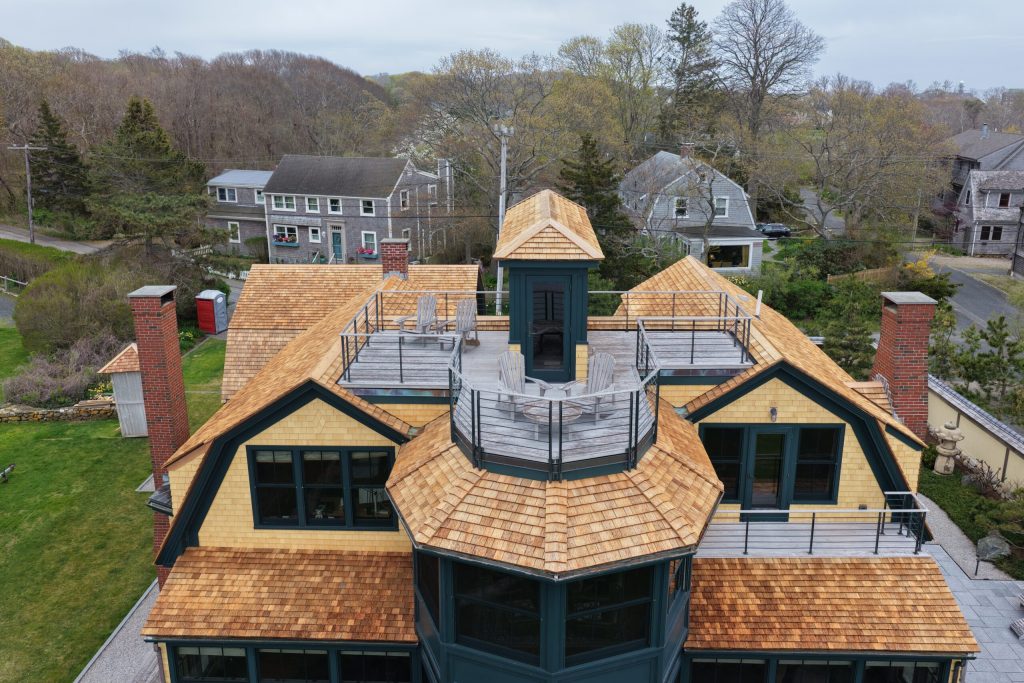
Red Cedar Roofing: Material Selection Beyond Visual Appeal
Red cedar isn’t chosen for waterfront properties simply for its warm, reddish-brown grain. Its cellular composition contains natural tannins and extractives that act as built-in biocides, resisting fungal colonization and insect infestation without chemical treatments. In Woods Hole’s marine climate, where salt spray accelerates corrosion and high humidity promotes moisture retention in roofing substrates, red cedar’s low density (≈32 lbs/ft³) and high dimensional stability make it uniquely suited.
We sourced premium-grade, quarter-sawn shingles with straight, tight grain patterns to minimize cupping and ensure uniform water shedding. The roof’s complex geometry—multiple pitches, dormers, a signature cupola, and multi-level terraces—required custom tapering and staggered exposure calculations. By maintaining a consistent 7-inch exposure and aligning shingles perpendicular to prevailing wind directions, we optimized both drainage efficiency and wind uplift resistance.
Over time, the roof will transition to a uniform silver-gray patina. This isn’t cosmetic aging; it’s a natural oxidation process that enhances surface durability by forming a protective, lignin-rich outer layer that further repels moisture.
Red Copper Flashing: Precision Water Management
Flashing is where roofing systems succeed or fail. For this project, we specified 20-oz cold-rolled red copper, fabricated on-site to accommodate the home’s intricate transitions. Copper’s coefficient of thermal expansion requires careful detailing: we engineered slip joints at all vertical-to-horizontal intersections and avoided rigid fastening that could induce stress fractures during seasonal temperature swings.
The custom flashing was integrated around masonry chimneys, dormer valleys, and the cupola base using a continuous, stepped approach that directs water away from vulnerable seams rather than trapping it. Unlike aluminum or galvanized steel, copper forms a self-healing oxide layer that seals micro-fractures over time. Within 3–5 years, the characteristic green verdigris will develop, but more importantly, the material’s antimicrobial properties will prevent organic buildup in drainage channels.
Every seam was hand-soldered using lead-free alloys, and all fasteners were concealed to prevent galvanic corrosion. The result isn’t just weatherproofing—it’s a dynamic moisture management system engineered for decades of coastal exposure.
Yellow Cedar Siding & The Structural Logic of Woven Corners
Alaskan yellow cedar was selected for the cladding not only for its pale, refined aesthetic but for its exceptional stiffness-to-weight ratio and natural decay resistance. Unlike standard corner boards—which rely on sealants that degrade under UV exposure—we implemented a traditional hand-woven corner system. This technique interlocks shingles from adjacent walls in a staggered, overlapping pattern, eliminating vertical seams where wind-driven rain typically penetrates.
Each corner required on-site templating, precise angle cutting, and sequential layering to maintain a continuous drainage plane. The installation protocol included a ventilated rain screen behind the cedar, allowing trapped moisture to evaporate while reducing thermal bridging. Fasteners were stainless steel, driven at consistent depths to avoid crushing wood fibers while ensuring pull-out resistance.
Woven corners aren’t merely decorative. They structurally reinforce wall intersections, distribute wind load more evenly, and extend the service life of the siding by 15–20% compared to conventional corner treatments. Achieving this level of precision across an entire facade requires years of specialized experience and real-time quality verification at every course.
EPDM Integration: Bridging Pitched and Flat Roof Systems
Modern coastal homes rarely feature a single roof plane. This property required seamless integration between pitched cedar sections and multiple flat terraces. We specified 60-mil black EPDM membrane for the low-slope areas due to its proven UV stability, ozone resistance, and elongation capacity (>300%), which accommodates structural movement without cracking.
The critical challenge was the transition zone where cedar shingles meet the EPDM edge. We designed a multi-layer termination detail: a continuous metal drip edge, reinforced EPDM peel-and-stick flashing, and a mechanically fastened termination bar sealed with polyurethane elastomeric caulk. All penetrations (drain scuppers, vent pipes, railing anchors) were reinforced with custom-fabricated neoprene boots and redundant sealant joints.
By avoiding direct adhesive contact between EPDM and cedar substrates, we prevented moisture trapping and allowed independent thermal expansion. The system was flood-tested before backfilling terrace substrates to verify zero leakage at transition points—a non-negotiable step for any coastal flat roof installation.
Execution Under Pressure: Coordinating Seven Craftsmen in 30 Days
Completing a full roof and siding replacement on a multi-elevation waterfront home in one month isn’t a matter of rushing. It’s a product of rigorous pre-planning, phased execution, and real-time quality control.
We divided the crew into specialized teams: roof demolition & substrate prep, cedar installation, copper fabrication, siding & corner weaving, and EPDM integration. Daily briefings aligned material deliveries with weather forecasts, as coastal humidity above 70% or sustained winds over 25 mph halt critical flashing and shingle steps. We implemented a rolling inspection protocol: every 500 sq ft of completed roofing was checked for exposure alignment, fastener depth, and underlayment continuity before proceeding to adjacent sections. Substrate repairs (rotted sheathing, compromised fascia) were addressed in parallel using marine-grade plywood and epoxy-consolidated framing.
The timeline succeeded because we prioritized structural integrity over speed, used pre-fabricated components where possible, and maintained redundant safety scaffolding to avoid weather-related downtime.
Long-Term Performance & What Owners Should Expect
Premium materials require informed stewardship. While red cedar and yellow cedar are exceptionally durable, coastal environments demand proactive maintenance. We recommend bi-annual inspections focusing on copper seam integrity, fastener corrosion, and drainage clearance. Gentle low-pressure rinsing removes salt buildup without damaging wood fibers; harsh power washing or chemical treatments should be avoided.
The natural patina development on both cedar and copper is not a defect—it’s a protective evolution. Expect the roof to achieve a uniform gray tone within 3–4 years, while copper transitions to verdigris over 5–10. With proper drainage maintenance and occasional spot-replacement of damaged shingles, the system will reliably exceed 50 years of service.
Final Notes for Coastal Renovations
Coastal upgrades demand more than premium materials—they require an understanding of environmental stressors, material behavior, and precision installation protocols. The Woods Hole project demonstrates how traditional craftsmanship, when combined with modern engineering principles, creates exteriors that perform as beautifully as they endure. For architects, builders, and homeowners navigating similar coastal upgrades, the difference between a temporary fix and a generational exterior lies in the details: moisture management, thermal accommodation, and uncompromising execution.