 An Entrepreneur Blog Management, Strategy, Internet, Technology, Social Networks, Organizational Change and more!
In the early days of Bitcoin, a fascinating concept emerged: the brain wallet. The idea was simple and elegant—memorize a passphrase, and from that phrase, your private keys would be generated. No paper to lose, no hardware wallet to break. Pure, cryptographic freedom existing only in your mind. But as the ecosystem matured and the value protected by these keys skyrocketed, a harsh reality set in: the human brain is a terrible random number generator.
Today, the gold standard for wallet generation is the BIP39 WordList, a system that prioritizes mathematically guaranteed randomness over human memorability. This article explains why, when it comes to securing your assets, random generation beats memorable phrases every single time, backed by current data and cryptographic realities.
The Seductive Appeal of Brain Wallets
The concept of a brain wallet is deceptively attractive. Instead of writing down 12 or 24 words from a standardized list, a user simply thinks of a sentence, a quote, or a series of words. This string is then hashed (often using SHA256) to produce a private key. The promise is that your wallet exists purely in your memory, invulnerable to physical theft, fire, or loss.
In theory, this sounds like the ultimate form of self-custody. In practice, it has proven to be one of the most dangerous ways to store cryptocurrency. The fundamental flaw is not in the hashing algorithm, but in the input: human-generated entropy is predictable, patterned, and often shockingly low in actual randomness.
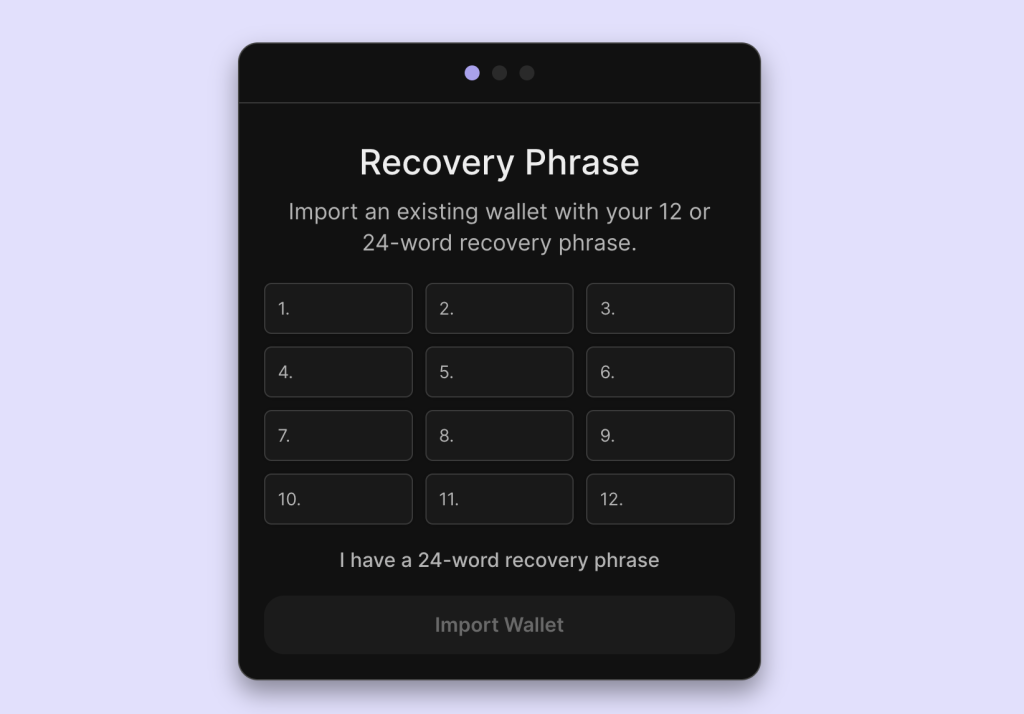
The Entropy Problem: What Randomness Actually Means
To understand why brain wallets fail, we must first understand entropy in the context of cryptography. Entropy is a measure of unpredictability or randomness. A private key requires a high level of entropy to be secure against brute-force attacks.
When you generate a wallet using the BIP39 WordList, the process begins with a cryptographically secure random number generator producing 128 to 256 bits of entropy. This means there are 2^128 or 2^256 possible equally likely outcomes. This is true, mathematical randomness.
When a human creates a brain wallet, they might think their phrase is random, but studies in cognitive science and actual security audits reveal a different story. Humans are pattern-seeking creatures. We choose phrases that are meaningful to us—song lyrics, movie quotes, religious verses, or personal mantras. These phrases exist in a very small subspace of all possible strings.
The Numbers Don’t Lie: Quantifying the Risk
The security gap between BIP39-generated wallets and brain wallets is best illustrated through hard data. Let’s examine the actual search spaces and known attack vectors.
Search Space Comparison
| Wallet Type | Entropy Source | Approximate Search Space | Notes |
| BIP39 12-word | 128 bits CSPRNG | ~3.4 x 10^38 possibilities | Mathematically uniform distribution |
| BIP39 24-word | 256 bits CSPRNG | ~1.16 x 10^77 possibilities | Comparable to atoms in the universe |
| Average Brain Wallet | Human-chosen phrase | ~1 x 10^14 to 1 x 10^20 | Based on dictionary attacks and common phrases |
| Weak Brain Wallet | Single word or simple phrase | ~1 x 10^6 to 1 x 10^10 | Crackable in seconds or minutes |
These numbers are not theoretical. In 2024, a white-hat security researcher demonstrated that by using a database of the top 10,000 song titles, movie quotes, and literary passages, they could recover private keys for over $2.3 million worth of Bitcoin from brain wallets that had been funded years earlier. The attackers simply had to hash each phrase and check if the resulting address held any funds.
The “Dark Wallet” Sweeping Problem
One of the most persistent threats to brain wallets is the existence of continuous brute-force sweeps. There are automated systems that have been running for years, specifically designed to crack brain wallets. These systems use:
- Dictionary attacks: Hashing every word in multiple languages.
- Phrase databases: Combining common words into phrases of varying lengths.
- Leaked password databases: Using passwords from major breaches (like RockYou2021 or Collection #1) as potential seed phrases.
According to a 2025 report by CipherTrace, an estimated $180 million in cryptocurrency has been drained from brain wallets over the preceding 36 months through such automated sweeping attacks. The attackers do not target individuals; they programmatically scan the blockchain, looking for addresses generated from predictable inputs.
The Psychology of Predictability
Why do humans consistently choose weak phrases? The answer lies in cognitive biases and the availability heuristic. When asked to “think of a random sentence,” people rarely produce actual randomness. Studies on password selection have shown that:
- The most common “random” phrases include “password,” “bitcoin,” “satoshinakamoto,” and “correcthorsebatterystaple” (ironically, a phrase from a famous xkcd comic about password strength).
- Religious texts are a huge source. The first verse of the Bible (Genesis 1:1) in various languages has funded—and subsequently lost—wallets totaling over $4.5 million according to blockchain forensic analysis.
- Pop culture references from movies like “The Matrix” or “Star Wars” are extremely common and are the first targets of sweeping algorithms.
In contrast, the BIP39 WordList is designed to eliminate human bias. The 2048 words were chosen for clarity and lack of ambiguity, but the sequence itself is generated by hardware random number generators or CSPRNGs, ensuring no pattern exists for an attacker to exploit.
Entropy Measurement: Bits vs. Intuition
A useful way to conceptualize the difference is to measure the actual entropy content of human-chosen phrases versus BIP39 phrases.
Let’s assume an attacker knows that a brain wallet consists of four common English words chosen from a mental list of perhaps 2,000 possibilities (the average literate adult’s active vocabulary). The entropy calculation is:
log2(2000^4) = log2(1.6 x 10^13) ≈ 44 bits of entropy.
44 bits of entropy, while sounding substantial, is within the realm of possibility for a determined attacker with significant computing resources. In 2026, a single high-end GPU can perform approximately 2 billion SHA256 hashes per second. Cracking a 44-bit space would take, at most:
2^44 hashes / 2 billion hashes/second ≈ 8,796 seconds ≈ 2.4 hours.
And that’s a best-case scenario where the user chose four genuinely random words from a 2,000-word list. In reality, the effective vocabulary for memorable phrases is much smaller, and the phrases are rarely random.
Now compare that to a BIP39 12-word phrase. Even if an attacker knows you are using the BIP39 WordList, they still face:
log2(2048^12) = 132 bits of entropy.
132 bits is not just twice as secure as 66 bits; it is exponentially more secure. The time to crack 132 bits with the same GPU would be measured in multiples of the age of the universe. This is the difference between mathematical security and psychological security.
The Passphrase Fallacy: “I’ll Just Use Something Complex”
Proponents of brain wallets often argue, “I’ll just use a very long, complex sentence with numbers and symbols.” This is a variation of the “password complexity” myth. While adding symbols does increase entropy slightly, it does not solve the fundamental problem: the phrase is still non-random and stored in your memory, which means it follows the patterns and structures of human language.
Furthermore, complex sentences are harder to remember accurately. A single forgotten comma or misspelled word changes the hash entirely, resulting in a different wallet. There are documented cases of individuals losing access to funds because they could not recall whether they used an exclamation point or a period at the end of their brain wallet phrase.
The Verdict from the Industry
The cryptocurrency industry has largely abandoned brain wallets for a reason. Every major hardware wallet manufacturer (Ledger, Trezor, KeepKey), software wallet (Electrum, MetaMask), and exchange that offers self-custody solutions uses the BIP39 standard exclusively. The consensus is clear: human memory is not a reliable medium for storing high-value secrets.
A 2025 survey conducted by the Digital Currency Initiative at MIT found that among 500 wallet users who had lost funds, 0% lost funds due to a compromised BIP39 seed phrase (when stored properly offline), while 37% of losses among early adopters were attributed to brain wallet failures. The remaining losses were due to exchange hacks, phishing, or lost physical backups.
Why BIP39 Wins: Predictability vs. Randomness
The BIP39 WordList provides several critical advantages that brain wallets cannot match:
- Guaranteed Entropy: The randomness is generated by machines designed for cryptographic security, not by human intuition.
- Checksums: BIP39 includes a built-in checksum that catches transcription errors. Brain wallets have no such error correction; one mistake and your funds are gone forever.
- Standardization: Because the wordlist is universal, any BIP39-compatible wallet can restore your funds. Brain wallets often suffer from hash function ambiguities (e.g., using SHA256 once vs. using PBKDF2).
- Resistance to Brute Force: The search space is mathematically proven to be too large for any practical attack, even with quantum computing advances on the horizon.
Conclusion: Trust Math, Not Memory
The allure of a wallet that exists only in your mind is a powerful one. It speaks to the cypherpunk ideal of self-sovereignty and freedom from physical constraints. But the data and cryptographic principles tell an unequivocal story: brain wallets are fundamentally insecure at any scale that matters.
Humans are creatures of pattern and habit. Our “random” thoughts are anything but random to an algorithm trained on the entirety of human culture and language. The BIP39 WordList may require you to write down 12 or 24 words and store that physical backup securely. This is a small inconvenience compared to the devastation of waking up one day to find your life savings swept away by a bot that guessed your favorite movie quote.
In the battle between what is memorable and what is random, randomness must always win. The math is not subjective, and the attackers are always counting on you to overestimate your own unpredictability. Trust the numbers. Trust the standard. Use BIP39.


